

Vivianite Grey Blue Pigment
Vivianite Grey Blue Pigment
Couldn't load pickup availability


Description
Vivianite Grey Blue is a natural pigment of crystalline vivianite, a hydrated iron phosphate mineral (Fe₃(PO₄)₂·8H₂O). Vivianite crystallises nearly colorless and deepens as its iron oxidises in the air, settling into a muted grey blue with a green cast. It is semi-transparent and very soft, so it glazes well and gives a quiet, earthy color rather than the brilliance of a mineral blue.
In use, Vivianite Grey Blue gives sober, atmospheric blues for shadow, distance, stone, weathered wood and overcast sky, and it is a natural partner to the earths. It mixes with white for cool dove greys and with yellow ochre for soft greens, and it reads deeper and bluer in oil than in the water based mediums. The pigment is soft and sensitive to grinding, so mix it into the binder with a palette knife rather than mulling it.
Keep it away from lime, strong acid and heat: lime darkens it, strong acids dissolve it, and temperatures much above 70 °C alter it, so it is not suitable for fresco, lime plaster or encaustic. Protect finished work from strong sun, and keep the dry pigment cool, dry and closed.
History
Vivianite was named in 1817 by Abraham Gottlob Werner, after the Cornish mineralogist John Henry Vivian. It forms where iron and phosphate meet in wet, airless ground, in bog iron and clay deposits and on buried bone, shell and wood, and it was long known to miners and farmers as blue iron earth or blue ochre. Because it was cheap and locally available, it served as a workaday blue in European painting, and it has been identified in sixteenth to eighteenth century works, particularly in the Netherlands and the German lands, often in skies, drapery and underlayers where a costly blue would not be justified. Its slow oxidation, from colorless through blue and blue green toward the yellow brown of metavivianite, is why vivianite in old paintings can read greyer or greener than the painter intended, and it has made the pigment a recurring subject in conservation studies of discolored blues.
Pigment Information
Pigment Type: Natural (Inorganic) iron phosphate mineral
Source: Natural crystalline vivianite (Fe₃(PO₄)₂·8H₂O), ground
Origin: Russia
Suitable Mediums: Oil, Egg Tempera, Watercolor, Gouache, Acrylic
Lightfastness: Fair to Good (Blue Wool 5.5 to 7.5)
Opacity: Semi-transparent, glazing
Other Names: Blue Iron Earth, Blue Ochre, Iron Phosphate Blue, Mullicite
Color Index Code: N/A
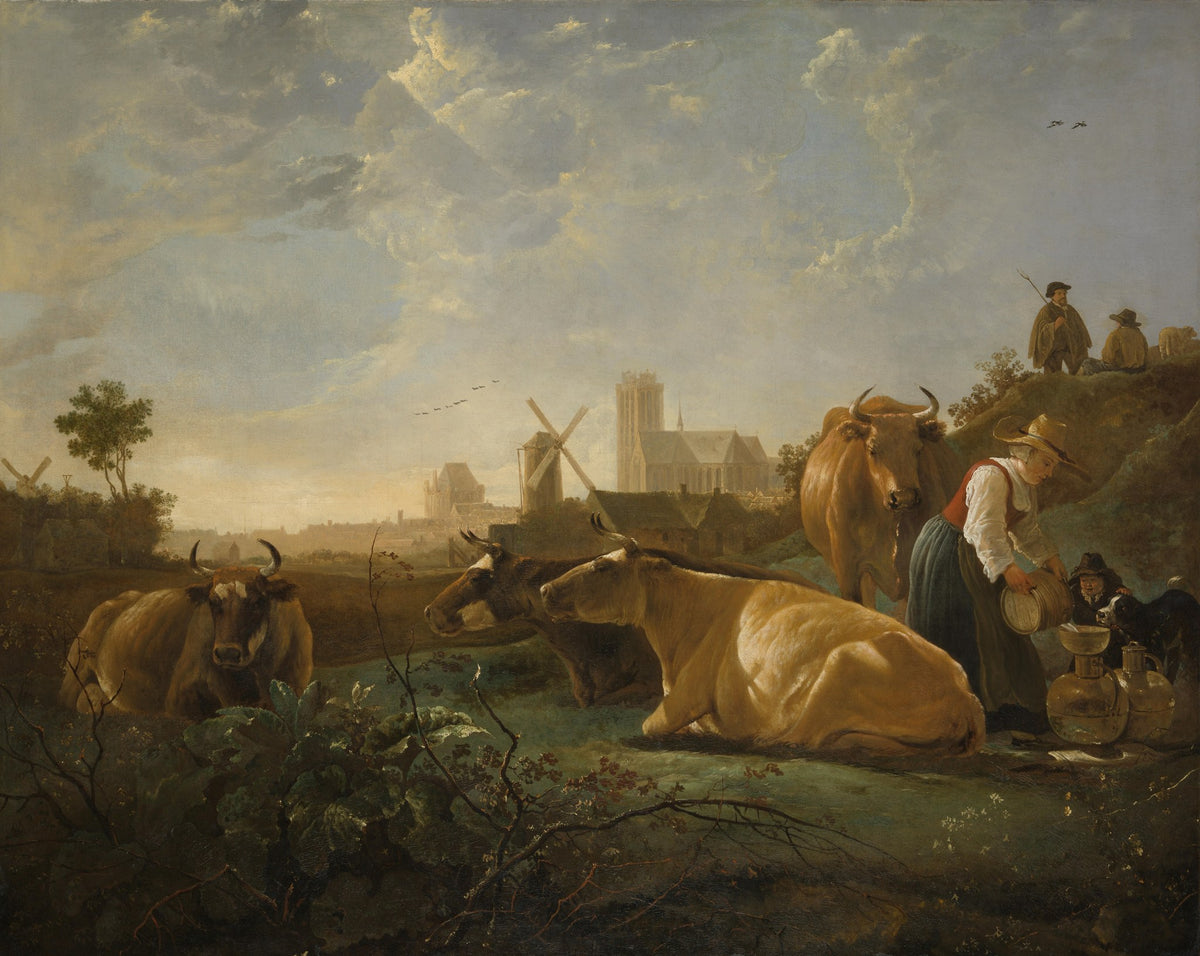
Image: 'The Large Dort' by Aelbert Cuyp from the National Gallery, London
Health and Safety
For art use only. Not for cosmetic, food or children's use.
Keep out of reach of children and pets. Do not eat, drink or smoke while working.
Avoid creating or breathing dust. Work in a ventilated area and wear a NIOSH approved dust respirator (P100 or better) when handling dry pigment.
Wear gloves and eye protection. Wash hands and work surfaces after use, and never rinse pigment into drains.
Do not spray apply, sand or burn.
If swallowed or if you feel unwell, contact a poison control center (U.S. 1-800-222-1222) or a doctor.
Safety Data Sheet available on request.