


Viridian Green Pigment
Viridian Green Pigment
Couldn't load pickup availability


Description
Viridian is a transparent green pigment made from hydrated chromium oxide. It produces a cool, clear blue-green with a refined, jewel-like quality and excellent permanence. Compared with earth greens, malachite, or green verditer, Viridian is cleaner, cooler, and more transparent. Compared with emerald green, it is less brilliant but far more stable and much safer to use.
As a pigment, Viridian is valued for its transparency, strength, and exceptional usefulness in mixtures. In masstone it appears as a deep, cool green, while in thin layers it creates luminous blue-green glazes and delicate transparent washes. It mixes beautifully with yellows to create fresh landscape greens, with blues for deep turquoise and pine greens, with reds for muted neutrals, and with earth pigments for naturalistic foliage and shadow tones.
Viridian is especially useful in watercolor, oil, acrylic, tempera, and glazing techniques. Its transparent character allows it to build color gradually without becoming heavy or chalky. It is one of the most important modern greens for landscape painting, botanical work, seascapes, atmospheric shadows, and cool color mixing. Its stability and clean handling made it one of the major replacements for more reactive historical copper and arsenic greens.
History
Viridian was developed in the 19th century as a stable hydrated chromium oxide green. Chromium chemistry had already produced several important pigments, including chrome yellow and chromium oxide green, but Viridian offered something different: a cool, transparent green with far greater permanence than many earlier bright greens.
Before Viridian became widely available, artists often relied on greens such as verdigris, copper resinate, malachite, green verditer, terre verte, and emerald green. Some of these were beautiful but unstable, while others were dull, weak, or highly toxic. Viridian provided artists with a reliable transparent green that could be used for glazing, mixing, and direct painting without the same level of chemical risk as copper resinate or emerald green.
By the second half of the 19th century, Viridian had become an important color in European painting. It was especially valued by landscape painters and Impressionists, who used it for foliage, water, shadows, and broken color mixtures. Its cool blue-green tone made it useful for outdoor light effects and for mixing a wide range of natural greens.
Today, Viridian remains one of the classic artist’s greens. Although modern phthalo greens are stronger and more intense, Viridian is still prized for its softer handling, transparency, permanence, and more naturalistic mixing behavior. It remains a standard pigment for artists who want a stable, historic, and refined green with excellent lightfastness.
Pigment Information
Pigment Type: Synthetic Inorganic
Chemical Composition: Hydrated Chromium Oxide, Cr2O3·2H2O
Suitable Mediums: Watercolor, Oil, Tempera, Gouache, Acrylic, Casein
Lightfastness: Excellent
Opacity: Transparent to Semi-transparent
Other Names: Viridian Green, Transparent Oxide of Chromium, Hydrated Chromium Oxide Green, Guignet’s Green, Vert Émeraude
Color Index Code: PG18
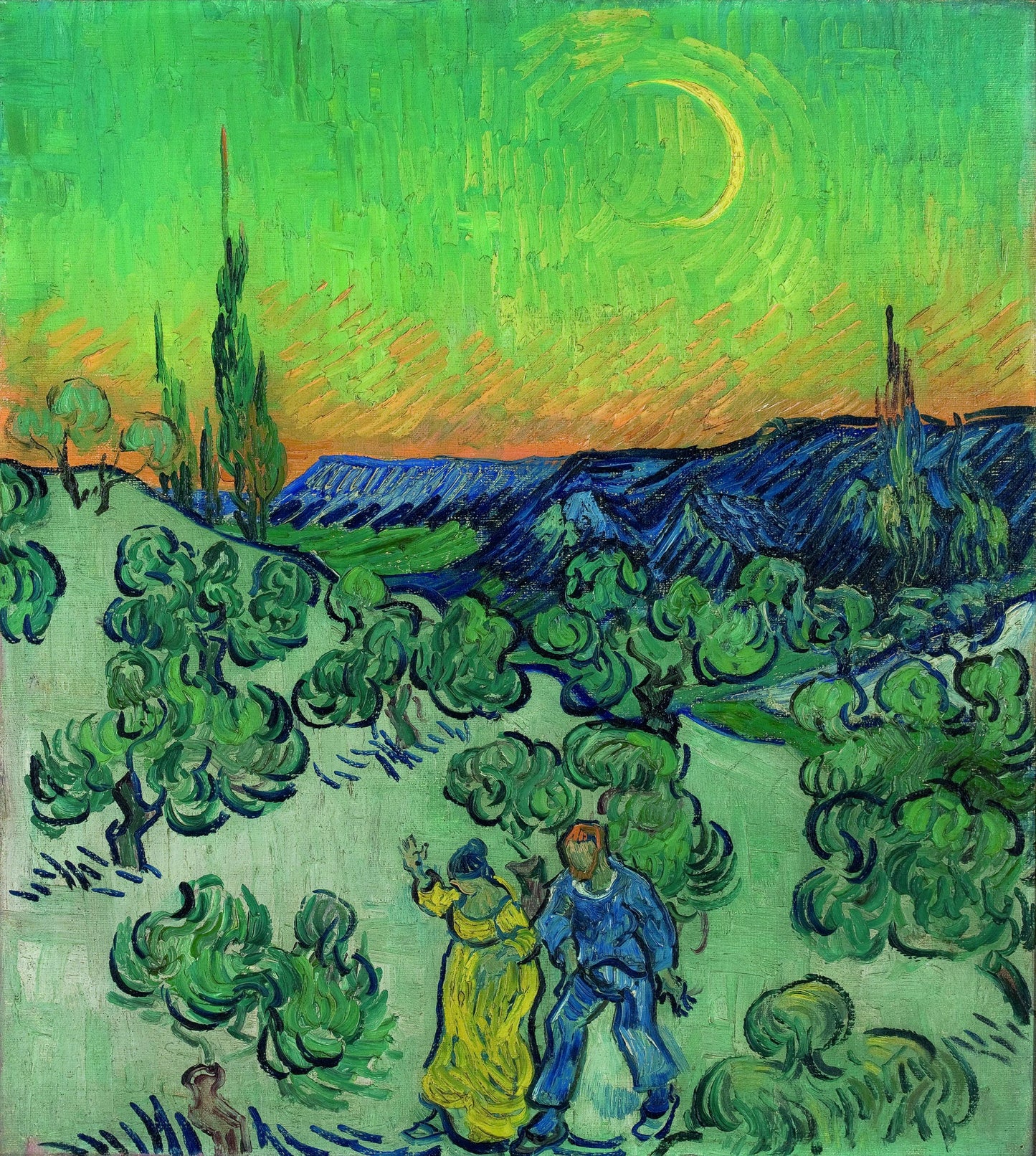
Pictured Artwork: Landscape With Couple Walking and Crescent Moon by Vincent van Gogh from the São Paulo Museum of Art