


Rhodusite Pigment
Rhodusite Pigment
Couldn't load pickup availability


Description
Rhodusite is a handmade natural pigment ground from rhodusite, the magnesium rich member of the riebeckite amphibole series (magnesio-riebeckite, a sodium magnesium iron silicate). It gives a cool, slightly greyed blue with a soft mineral body and a faint silky sheen, paler and quieter than azurite and cooler than the blue earths.
In use, Rhodusite gives restrained, smoky blues for sky, distance, shadow and stone, and it holds its character well in lime, fresco and tempera. It mixes with white for cool pale blues and with the earths for muted blue greys. It is chemically stable, lightfast and unaffected by alkali, which makes it well suited to wall painting.
History
Rhodusite takes its name from the island of Rhodes, where the mineral was first described in the late nineteenth century. Its colour comes from iron in the crystal structure rather than from copper, as in the classical mineral blues.
Its history as a pigment belongs to the Bronze Age Aegean, where it was one of only two blues the wall painters had. It was first identified in a wall painting in 1976, in the Unexplored Mansion at Knossos, where it was taken for glaucophane; later analysis of the Akrotiri paintings on Thera showed the bright blue mineral to be magnesio-riebeckite, since true glaucophane is a dull grey blue that turns grey when ground. It accounts for about half the blue samples from Knossos and most of those from Akrotiri, and it has also been found at Chania, Phaistos, Ayia Triadha, Kommos and Palaikastro, the last two using mineral blue alone. A raw five centimetre piece of it was found in the painters' stock at Akrotiri.
Minoan painters did not treat it as a cheap substitute for imported Egyptian blue; they chose between the two for how each one looked. Rhodusite gave the grey blues of open sea, reeds and rock, while Egyptian blue went to the brighter blues of rivers, dolphins, palm leaves, garments and jewellery, and the two were mixed. In the blue spirals of Xeste 3, some twenty five square metres of wall, a thin coat of fine Egyptian blue was laid over a thick layer of coarser rhodusite, which deepened the colour and helped it hold to the plaster. The mineral appears only between about 1700 and 1500 BCE: the stone at Knossos matches Thera's, so it was most likely brought from the island, and after the eruption it vanishes from the record, leaving Egyptian blue as the only blue at Knossos.
Pigment Information
Pigment Type: Natural (Inorganic) sodium magnesium iron silicate mineral
Source: Natural rhodusite / magnesio-riebeckite, crushed and ground
Origin: Greece
Suitable Mediums: Watercolor, Gouache, Oil, Tempera, Casein, Encaustic, Lime / Fresco
Lightfastness: Excellent
Opacity: Semi-opaque
Other Names: Magnesio-riebeckite, Blue Amphibole, Magnesioriebeckite
Color Index Code: N/A
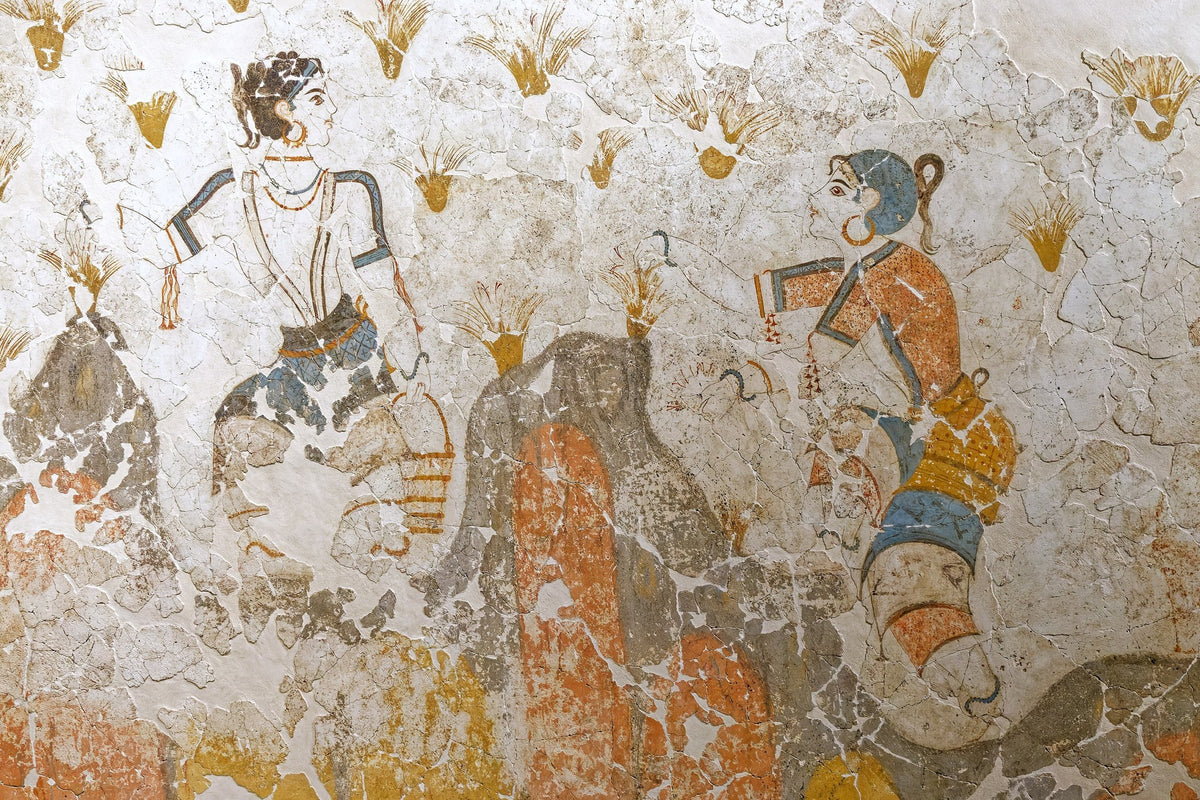
Image: the Saffron Gatherers fresco from Akrotiri, 17th century BCE
Health and Safety
For art use only. Not for cosmetic, food or children's use.
Keep out of reach of children and pets. Do not eat, drink or smoke while working.
Avoid creating or breathing dust. Work in a ventilated area and wear a NIOSH approved dust respirator (P100 or better) when handling dry pigment.
Wear gloves and eye protection. Wash hands and work surfaces after use, and never rinse pigment into drains.
Do not spray apply, sand or burn.
If swallowed or if you feel unwell, contact a poison control center (U.S. 1-800-222-1222) or a doctor.
Safety Data Sheet available on request.
Caution: Keep the pigment damp wherever you can, and never dry sand, grind or abrade it. Work with ventilation and wear a P100 respirator whenever you handle it dry.
Caution: Natural earths and minerals contain crystalline silica (quartz). Breathing the dust over long periods can cause serious lung disease (silicosis) and lung cancer. Always use a dust respirator with the dry pigment.