


Lead White Pigment
Lead White Pigment
Couldn't load pickup availability

Description
Lead White is a handmade single pigment made through a chemical reaction similar to the historical process known as the "stack process," in which metallic lead sheets were exposed to vinegar fumes and carbon dioxide, allowing lead carbonate to form over time. This method produced an exceptionally smooth, highly opaque, and flexible white pigment that has been revered by artists for centuries. Lead White is prized for its warm undertones, excellent blending properties, and unparalleled handling in oil painting. Lead white must be used with gloves and a respirator in dry form as it is not non-toxic.
Lead White has exceptional lightfastness, making it highly durable for both classical and contemporary artwork. It blends seamlessly with other pigments, offering bright highlights and a warm, natural tone in paintings. Its semi-opaque quality allows for superior layering, glazing, and soft color transitions in oil and tempera applications. Compared to modern whites such as Titanium or Zinc White, Lead White has unique rheological properties, improving the flow and flexibility of oil paints while reducing brittleness and being much more transparent than both Zinc and Titanium White.
History
White pigments have been essential in painting for millennia, with Lead White being the dominant choice for artists until the 20th century.
During antiquity, the ancient Egyptians, Greeks, and Romans produced Lead White for use in frescoes, decorative arts, and cosmetics. The Romans refined its production, using vinegar and lead sheets to accelerate the formation of basic lead carbonate.
In the Middle Ages and Renaissance, Lead White became the most important white pigment for manuscript illumination, frescoes, and panel painting. It was the preferred white for artists such as Leonardo da Vinci, Rembrandt, and Vermeer, who valued its warm, luminous quality and smooth blending.
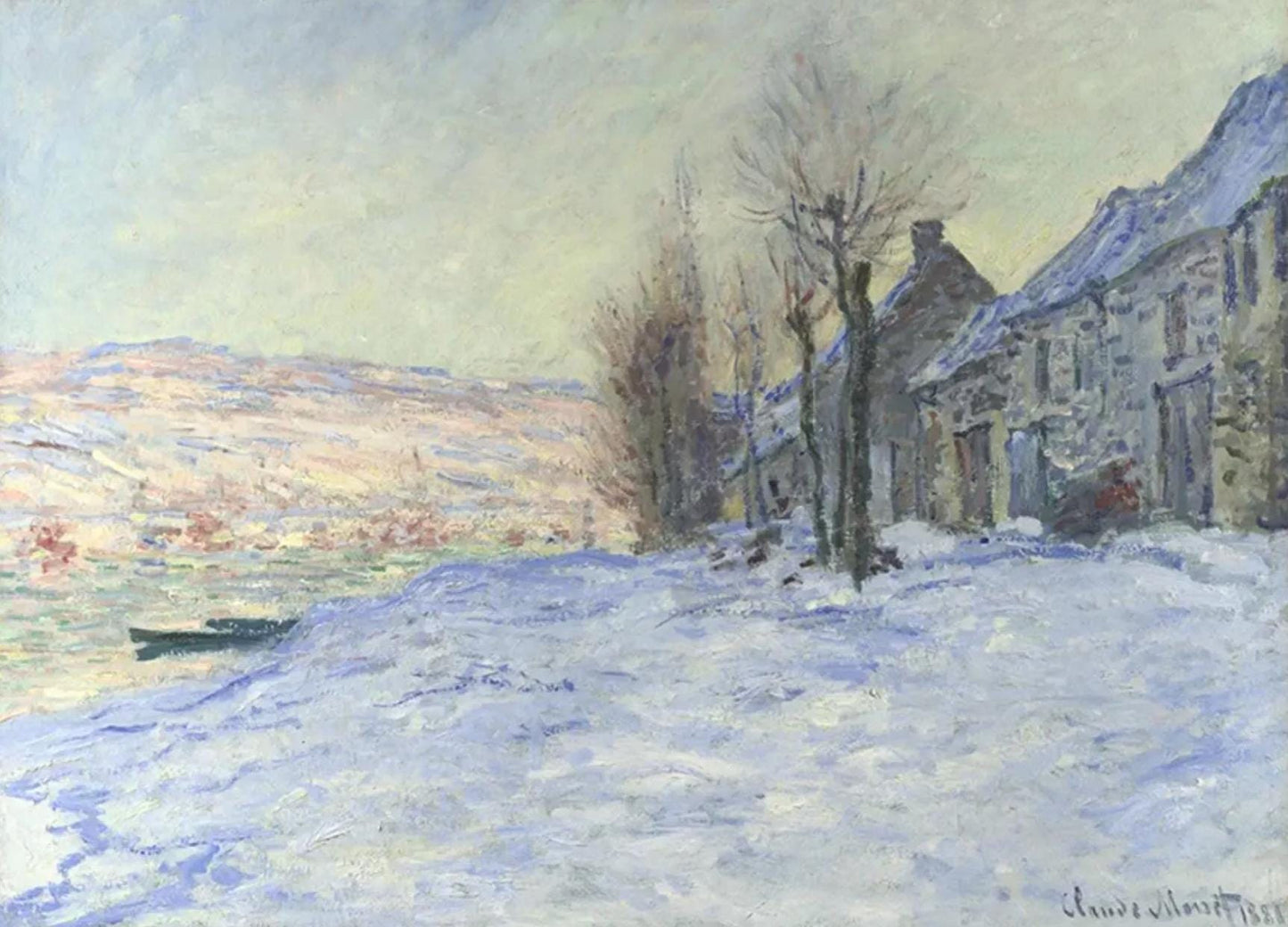
By the 18th and 19th centuries, Lead White was the standard white pigment in oil painting, used in nearly all European painting traditions. However, concerns over lead toxicity led to the development of alternative whites, such as Zinc White and later Titanium White. In the pictured artwork 'Lavacourt under Snow' by Claude Monet, lead white serves as the primary pigment throughout for the bright tints of the snow, sky, and buildings.
In the 20th century, the production of Lead White was restricted in many countries due to health concerns. It remains legal for professional artists in some regions, particularly for historical and restoration work, but is no longer widely manufactured for general use.
Today, Lead White is still sought after by conservators, traditional oil painters, and restoration specialists for its unique properties, despite its toxicity and limited availability.
CONTAINS LEAD. WEAR P100 FULL FACE OR HALF FACE PLUS GOGGLES RESPIRATOR. DO NOT SWALLOW OR INHALE. WEAR GLOVES AND DO NOT ALLOW IT TO BE ABSORBED THROUGH SKIN. P95 IS NOT SUFFICIENT.
Pigment Information
Pigment Type: Synthetic (Lead Carbonate) from minerals (2PbCO₃·Pb(OH)₂)
Suitable Mediums: Oil, Tempera
Lightfastness: Best
Opacity: Semi-opaque
Other Names: Flake White, Cremnitz White, Bianco di Piombo
Color Index Code: PW1
Image: 'Lavacourt under Snow' by Claude Monet from the National Gallery