

Bismuth Oxide Yellow Pigment
Bismuth Oxide Yellow Pigment
Couldn't load pickup availability
Description
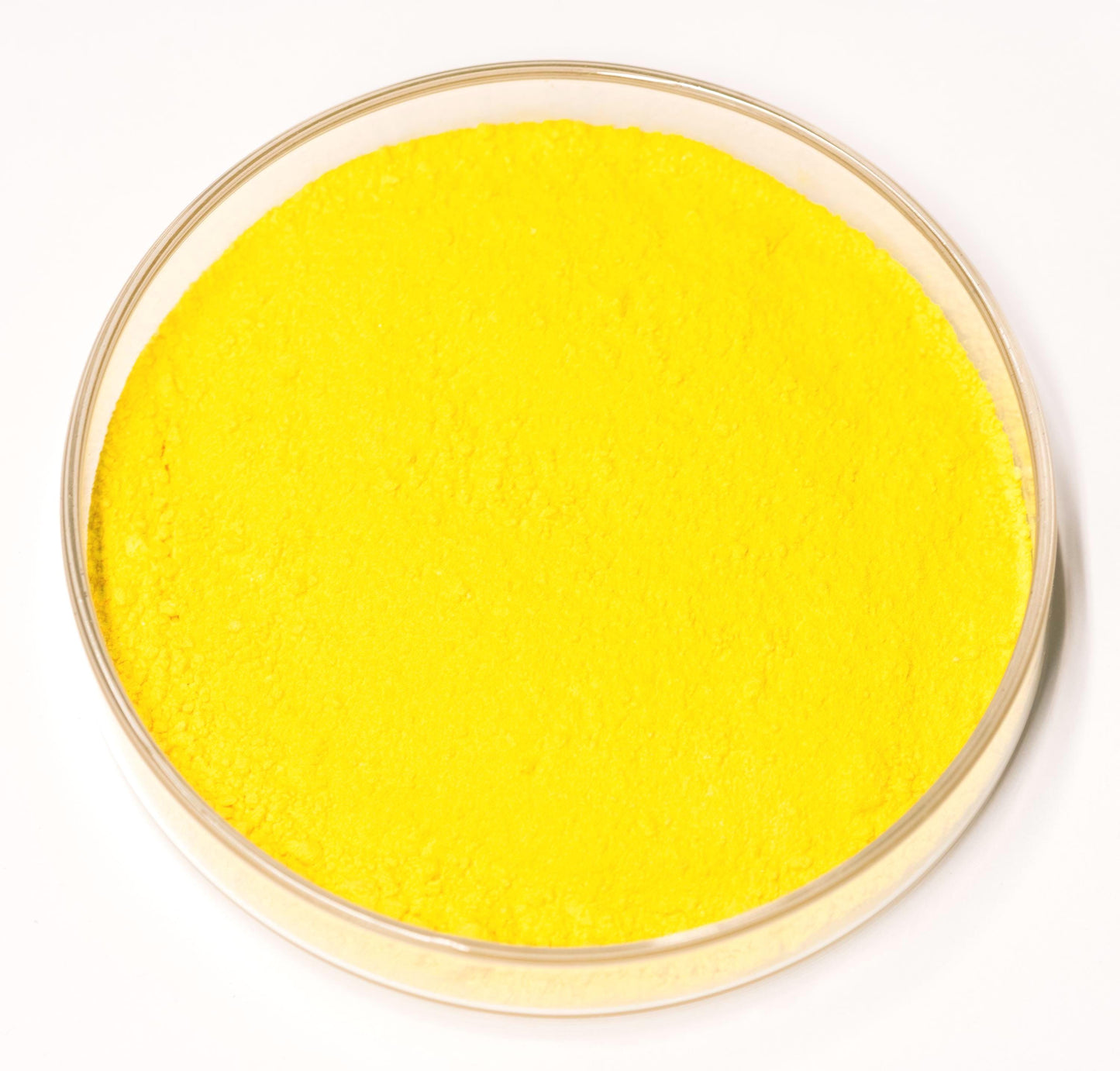
Bismuth Oxide Yellow is a synthetic inorganic yellow pigment based on bismuth trioxide. It produces a warm, opaque yellow with a soft golden cast, sitting between Verona Yellow Ochre, Naples yellow, and warm lemon-yellow depending on medium. Unlike organic yellows, which can be highly transparent and staining, Bismuth Oxide Yellow has a dense mineral body and a more grounded, rich character.
In use, Bismuth Oxide Yellow gives strong covering power, a smooth handling quality, and a warm, stable yellow useful for flesh tones, highlights, architectural details, botanical work, manuscript-inspired painting, and historical palettes. It mixes well with earth pigments, reds, greens, whites, and blacks, producing soft creams, warm oranges, muted greens, and naturalistic yellow-greys. Its opacity makes it especially useful where a solid yellow passage is needed rather than a transparent glaze.
Bismuth trioxide is chemically distinct from traditional yellow pigments such as yellow ochre, lead-tin yellow, or Naples yellow. It offers a heavy-metal mineral yellow without relying on lead, arsenic, or cadmium compounds. Its color is not as brilliant as many modern synthetic yellows, but it has a refined, slightly rich warmth that works beautifully in traditional and conservation-oriented palettes.
History
Bismuth compounds have been known for centuries in alchemical, metallurgical, ceramic, and medicinal contexts. Bismuth itself was historically associated with tin, lead, and silver because of its pale metallic appearance, while its oxides were studied for their unusual colors, weight, and behavior in heat.
Bismuth trioxide, the yellow oxide of bismuth, became important in chemistry, ceramics, glassmaking, and later technical materials. In ceramic and glass applications, bismuth oxide has been valued as a flux and color-influencing material, contributing to yellowish tones and modifying melt behavior. As an artist’s pigment, however, Bismuth Oxide Yellow has remained uncommon compared with earth yellows, lead-tin yellow, Naples yellow, chrome yellow, cadmium yellow, and modern organic yellows.
Its interest today comes from its unusual position between historical heavy-metal chemistry and modern safer pigment exploration. It provides a warm inorganic yellow based on bismuth rather than lead, cadmium, chromium, or arsenic. For artists, conservators, and pigment researchers, Bismuth Oxide Yellow is useful as a rare mineral yellow with strong opacity, good permanence, and a distinctive material identity.
Though not one of the dominant named pigments of the Renaissance or Baroque palette, it belongs to the broader family of historical and technical bismuth materials. Its use is especially appropriate for experimental painting, pigment research, ceramic-inspired palettes, and artists seeking unusual inorganic yellows with a dense, mineral character.
Pigment Information
Pigment Type: Synthetic Inorganic
Chemical Composition: Bismuth Trioxide, Bi2O3
Suitable Mediums: Watercolor, Gouache, Tempera, Acrylic, Oil, Casein, Ceramic and Glass Studies
Lightfastness: Excellent
Opacity: Opaque
Other Names: Bismuth Yellow, Bismuth Oxide Yellow, Bismuth Trioxide, Bismite Synthetic
Color Index Code: NA