


Bismuth Metal Pigment
Bismuth Metal Pigment
Couldn't load pickup availability


Description
Bismuth Metal Powder is a historic metallic grey pigment based on finely powdered elemental bismuth, a heavy metal that produces a cool, silvery grey to dark graphite-grey tone. Unlike shell silver or powdered tin, bismuth does not retain a bright metallic brilliance once ground into paint. Instead, it gives a subdued, mineral grey with a slightly pinkish, silvery cast and a distinctive heavy, opaque character.
In use, Bismuth Metal Powder gives a rare historical grey useful for architectural passages, stonework, shadowed ornament, metal studies, historical reconstruction, and Renaissance-inspired painting. It has strong covering power and a cool, dark grey masstone that differs from carbon black, bone black, or mixed greys made from black and white. Where black pigments can feel brown, blue, or overly deep, bismuth gives a quieter grey with a dense, mineral body.
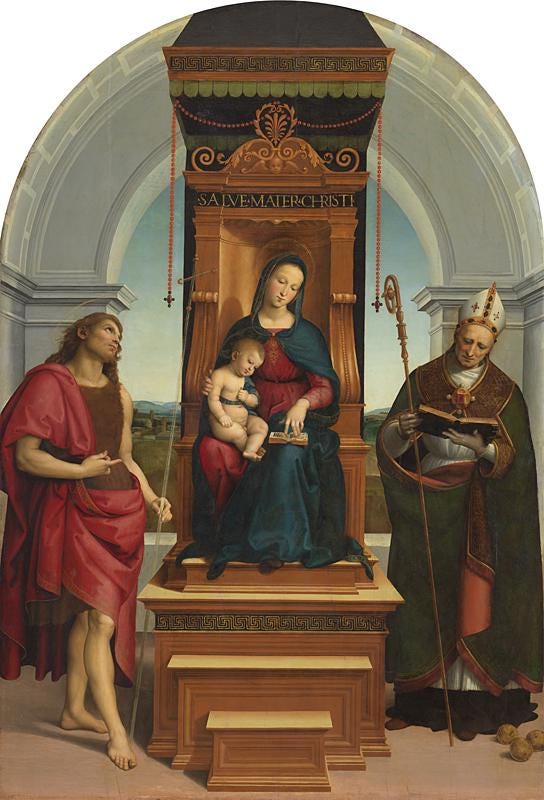
Raphael used powdered metallic bismuth in The Ansidei Madonna, painted in 1505 and now in the National Gallery, London. Technical analysis identified bismuth in the light grey architectural setting, mixed with lead white. Cross-section study showed small pinkish-grey particles with a metallic lustre, and the material was confirmed as metallic bismuth by SEM-EDX and X-ray diffraction. Researchers note that Raphael did not use it to create a bright metallic effect, but likely chose it because it produced an atmospheric grey rather than a true black.
History
Bismuth was known in late medieval and Renaissance Europe as an unusual metal associated with silver and tin. In early alchemical and metallurgical traditions, it was sometimes understood as a metal related to silver, and its pale silvery appearance made it useful in several branches of the decorative arts. As a painting material, however, powdered bismuth was rare.
Its use has been identified in a small number of early sixteenth-century paintings, making it one of the more unusual materials in the Renaissance palette. In Raphael’s The Ansidei Madonna, bismuth appears in the grey architecture of the painted setting. This is especially important because it shows Raphael selecting a specific grey material rather than simply mixing a conventional black with white. The National Gallery describes this as a “most unusual silvery pigment” found in the architecture, and technical research identifies it as powdered metallic bismuth.
Bismuth-containing grey pigments have also been reported in works by Fra Bartolommeo, Francesco Granacci, and in French manuscript painting around 1500, though the material remains uncommon compared with traditional blacks, earths, lead white, azurite, ultramarine, verdigris, and lead-tin yellow. In this context, Bismuth Metal Powder represents a highly specialized historical material: not a substitute for silver leaf, but a rare metallic grey pigment used for tonal control, architecture, and subtle painted effects.
Pigment Information
Pigment Type: Elemental metallic pigment
Source: Finely powdered bismuth metal
Chemical Composition: Bi
Suitable Mediums: Oil, Tempera, Encaustic, Watercolor
Lightfastness: Excellent
Opacity: Opaque
Other Names: Powdered Bismuth, Metallic Bismuth, Bismuth Grey, Bismuth Metal Pigment
Color Index Code: NA
Image: The Ansidei Madonna by Raphael, National Gallery, London